Code of the Day: Unauthenticated Root in Copeland XWEB EVO
VulnCheck's Initial Access Intelligence team discloses 14 vulnerabilities in the Dixell / Copeland XWEB EVO refrigeration supervisor, including unauthenticated remote root on both the legacy builds and the current end-of-support firmware, where the login handler runs the submitted username as a shell command before the password check, the interpreter behind every page is setuid root, and the daily admin credential is a secret-free function of the device MAC and the date.
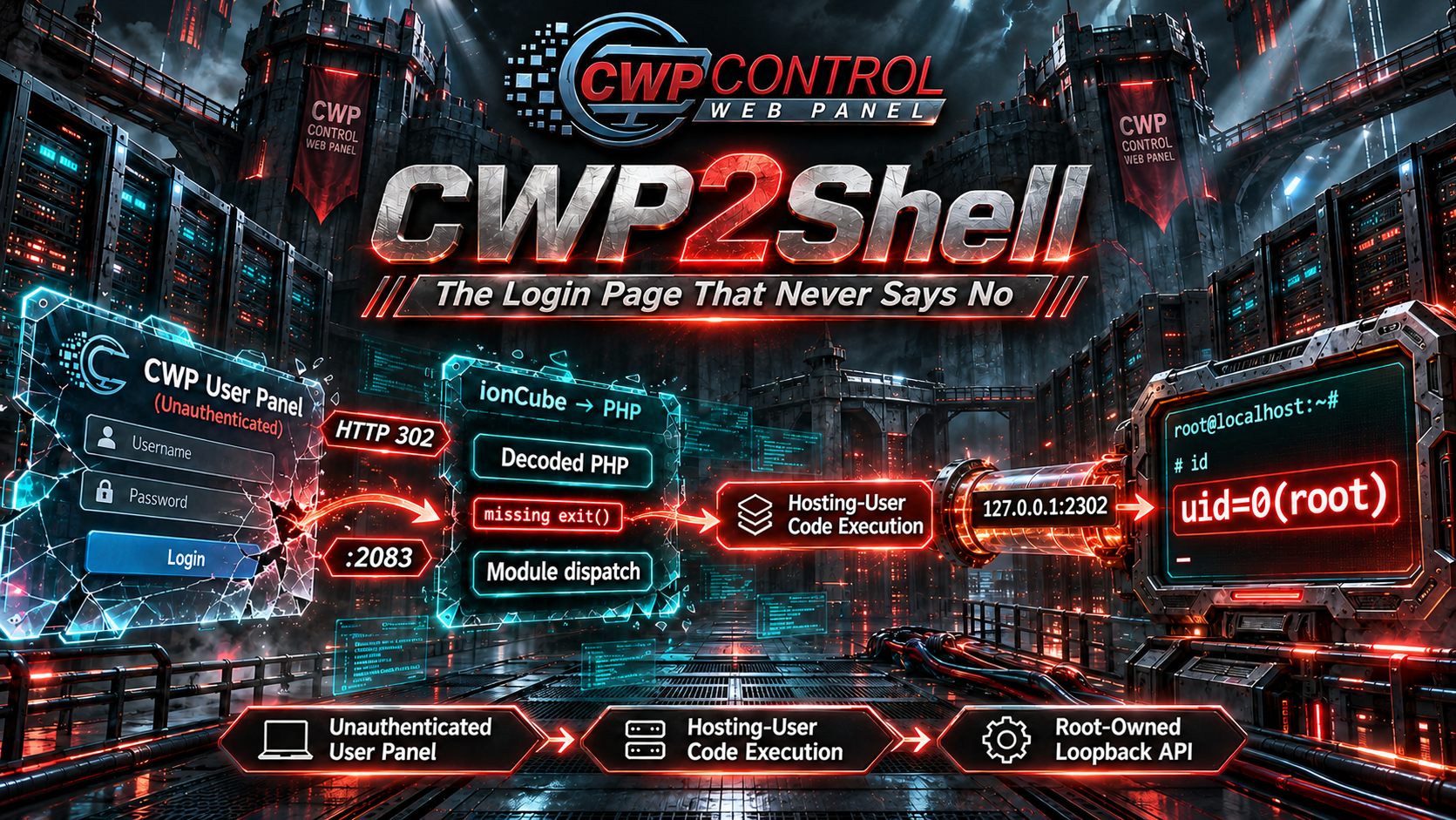
CWP2Shell: The Login Page That Never Says No
VulnCheck's Initial Access Intelligence team details an unauthenticated pre-auth remote root RCE chain in Control Web Panel, where the user panel emits its login redirect without stopping execution, so an attacker-named module file runs before authentication and a root-owned user API turns that foothold into uid 0.
SPIP odt2spip Plugin: Authenticated Command Injection via Uploaded Document Filename
VulnCheck's Initial Access Intelligence team details an authenticated OS command injection in the SPIP odt2spip plugin, where an uploaded document's filename is concatenated into a shell command and run, giving any low-privileged author remote code execution as the web server user.
Virtualizor: The Login Parameter That Skips the Login
VulnCheck's Initial Access Intelligence team details an unauthenticated remote root RCE in the Virtualizor admin panel, where the pre-auth billing-module hook is guarded only against requests whose act is not 'login', so act=login walks straight into it, the hook unserializes an attacker POST field and splices its uid into a root shell, and the parameterized queries do not help because MySQL casts the injected string back to the integer the query expects.
FileRun: Four More Ways to Run Your Files
Four authenticated RCEs in FileRun. A contact-sheet handler and a settings test endpoint run attacker input through a shell, and a delegated administrator turns a control-panel field into stacked SQL that a permission-blob deserialization weaponizes into a webshell. All fixed in 2026.3.0.
FileRun: When Your File Manager Runs Your Files
OS Command Injection in FileRun's thumbnail generation - authenticated (CVSS v4 8.7) or via public 'file request' weblinks (CVSS v4 9.2). The extractors wrap file paths in double quotes and pass them to exec(), but the filename sanitizer allows $(){}` - enough for command substitution. The weblink path uploads a malicious filename via anonymous upload, then self-triggers thumbnail generation through the public listing.
openDCIM: From SQL Injection to RCE via Config Poisoning
Three chained vulnerabilities in openDCIM turn a missing authorization check into unauthenticated remote code execution on Docker deployments.